
Weak Password Hashing: Why a Leaked SHA-1 Table Cracks in Milliseconds
October 29, 2026
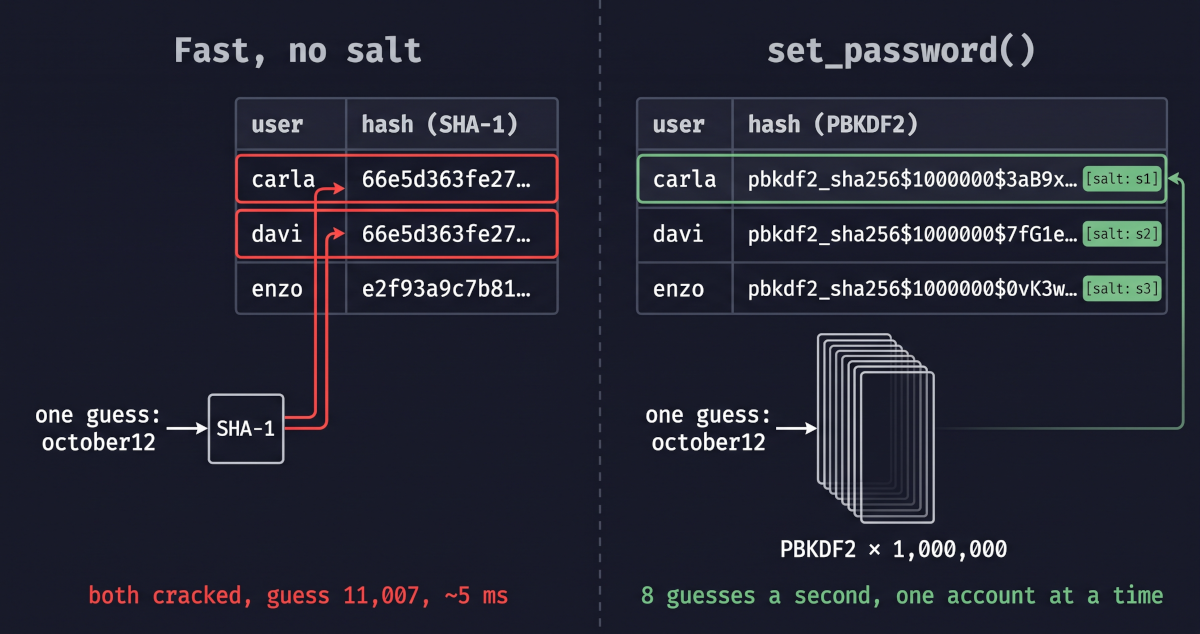
Password hashing in Django: why a hand-hashed SHA-1 column falls to one offline pass, and how set_password() and a wrapped hasher fix it. OWASP A04.
I'm a career-transition professional pairing 20+ years in the legal sector with hands-on security engineering. Rather than just describe the journey, I'd rather show what I've built and the credentials that back it.
What I've shipped
Verified credentials
Postgraduate degree in Digital Security (10.0/10.0 — PUCRS); CompTIA Security+, Network+, and Cybersecurity Analyst+ (CySA+); and the Security Analytics Professional (CSAP) stackable certification. Currently completing a Cybersecurity Risk Management diploma with Co-op at CCTB (Vancouver). Admitted to the University of Victoria's Master of Engineering in Telecommunications and Information Security (January–December 2027), to deepen the engineering foundation behind the security work I already ship. Every badge is third-party verifiable on Credly — see the Certifications section below.
What I bring
The same discipline that governs legal evidence — documentation rigor, chain-of-custody, regulatory literacy (LGPD/GDPR) — applied to building and securing software, backed by production systems I've already shipped. I'm targeting Security Engineer roles: application security, DevSecOps, and secure software delivery.
Based in Vancouver, BC, and moving to Victoria, BC, in January 2027. Reach out via Email or connect on LinkedIn.
Bilingual (EN/PT) Django security series mapped to CySA+ CS0-003 & OWASP Top 10
An ongoing weekly learning journal — published every Thursday in English and Portuguese simultaneously — documenting my transition from law into application security. Each post dissects a real web attack, shows how to defend against it in Django, and ships that defence as a public, runnable lab: a vulnerable view and a secure view you can clone and boot, then scan with the same off-the-shelf tools a security analyst actually uses — Bandit and Semgrep (SAST) and pip-audit (SCA), green in CI on every commit, plus a captured sqlmap run (DAST) where the class fits. The labs live in an open companion repository (django-security-lab), so any reader can reproduce every result with a git clone and docker compose up instead of taking my word for it. Every attack is cross-referenced to the CompTIA CySA+ CS0-003 objectives, the OWASP Top 10:2025, MITRE ATT&CK techniques, and the NIST Cybersecurity Framework.
What makes it different: proof of work is an artifact you run, not a screenshot you trust — clone the lab, point the standard scanners at it, and watch them flag the vulnerable view and stay silent on the secure one. It's grounded in real production experience from projects like Petição Brasil and paired with LGPD/regulatory analysis from my legal background. The roadmap spans the full OWASP Top 10 — Injection, Broken Access Control, Authentication & Session, Cryptographic Failures, Security Misconfiguration, Insecure Deserialization, Concurrency & Resource Abuse, Logging & Monitoring, SSRF, API Security, Software Supply Chain Failures, and Failure Modes.
Final Paper — PUC-RS (Score: 10/10)
Published a final paper with a perfect score of 10/10, exploring the intersection of Direct Democracy and Information Assurance. Developed a technical framework applying the CIANA Pentagon (Confidentiality, Integrity, Availability, Non-repudiation, Authentication) to validate digital petitions using ICP-Brasil PKI infrastructure and SHA-256 cryptographic signatures.
The research evolved into Petição Brasil — a live civic-tech platform described as the only Brazilian platform that unites participatory democracy and legal security. Citizens create public petitions, sign them with any ICP-Brasil certificate (Gov.br, e-CPF, A1/A3), and receive an automatically generated chain-of-custody PDF with cryptographic evidence and QR code — giving petitions the same legal standing as physical documents before public bodies, legislative chambers, and courts. The platform also enables Popular Legislative Initiative (Brazilian Constitutional Art. 61, §2º), making it the first fully digital, zero-cost path for any citizen to propose laws to Congress. LGPD-compliant, free forever, and privacy by design.
Full-Stack Django Application | Brazilian Legal Tech
Full-stack Django application to centralize the management of judicial precatórios (court-ordered government debt instruments) issued against Brazilian public entities, built for a law firm with thousands of clients.
Tracks each precatório (government debt writ) by CNJ (Conselho Nacional de Justiça — National Council of Justice) number with independent payment statuses for three financial components: crédito principal (principal debt), honorários contratuais (contractual attorney fees), and honorários sucumbenciais (loser-pays attorney fees). Includes client/CPF (Cadastro de Pessoas Físicas — Brazilian taxpayer ID) management, alvará (court payment order) and requerimento (formal petition) workflows with configurable phase pipelines, a diligências (legal task) tracker with urgency and deadline controls, secure 50 MB PDF uploads to AWS S3, financial dashboard aggregates, and a bulk Excel import pipeline. Deployed on Heroku with PostgreSQL and gunicorn.
VBA/Excel Legal-Tech (2014) → Web Application (2020–Present)
Engineered a proprietary payroll calculation engine in VBA and Excel to automate the computation of labor entitlements for approximately 30,000 public servants of the State of Maranhão — replacing entirely manual processes prone to error in high-stakes court submissions.
The system handled complex Brazilian labor legislation rules (cálculos trabalhistas), including overtime, vacation pay, severance, and retroactive adjustments, producing outputs with the mathematical precision required for judicial use. At peak, it processed the financial claims of the entire public education workforce of a Brazilian state.
In 2020, led the migration of the system to a web-based architecture, managing the full development lifecycle: requirements gathering, contractor hiring, and technical supervision of an external development team — delivering a production system currently at v1.4.16.


ETS (Educational Testing Service)
Issued Jun 2026 · Exp. Jun 2028
Feb 2014 — Present (12 years)
Build full-stack web applications and automation tools in Python/Django (and earlier VBA) for the legal sector, with a focus on data integrity and secure authentication. Flagship builds — the Petição Brasil ICP-Brasil digital-signature platform, a Judicial Debt (precatórios) Management System, and a public-payroll calculation engine — are detailed in the Projects section above.
Mar 2012 — Mar 2026 (14 years)
Led a legal and operations team of 30+ professionals across four locations, standardizing investigative, analytical, and compliance workflows for a 20,000+ client portfolio. Analyzed complex contracts and case evidence to identify risk, build strategy, and ensure regulatory compliance — the evidence rigor and risk analysis I now apply to security engineering. Also authored a long-running Public Law blog at thiagohenrique.adv.br.
Sep 2010 — Feb 2012 (1 year)
Provided comprehensive legal counsel and representation for public educators across the State of Maranhão, managing a high volume of specialized public sector litigation.
Dec 2004 — Aug 2010 (5 years)
Developed a comprehensive understanding of firm operations, progressing through multiple support roles to ensure efficient daily administrative and legal workflows.
Jan 2027 — Dec 2027 · Admitted
Graduate engineering program in network and information security. Planned focus: secure software delivery and DevSecOps, extending the work in my Django security lab.
2025 — Present
Furthering technical specialization in Cybersecurity Risk Management. Program covers network security, systems hardening, risk assessment, and co-operative work placement in the Canadian tech sector. (Academic coursework completed; co-op in progress.)
2024 — 2026 · 10.0 / 10.0
Digital security with an emphasis on applied cryptography and public-key infrastructure — the foundation of my ICP-Brasil digital-signature final paper (10/10) — alongside data governance and data protection. Competencies: Applied Cryptography, PKI, Data Protection, Security Architecture, Risk Management.
Credential evaluated by World Education Services (WES) — Verify
2022 — 2024 · 9.7 / 10.0
Advanced specialization in Public and Constitutional Law — administrative law, constitutional principles, and public-sector governance.
2005 — 2010
Credential evaluated by World Education Services (WES) — Verify
October 29, 2026
Password hashing in Django: why a hand-hashed SHA-1 column falls to one offline pass, and how set_password() and a wrapped hasher fix it. OWASP A04.
October 22, 2026
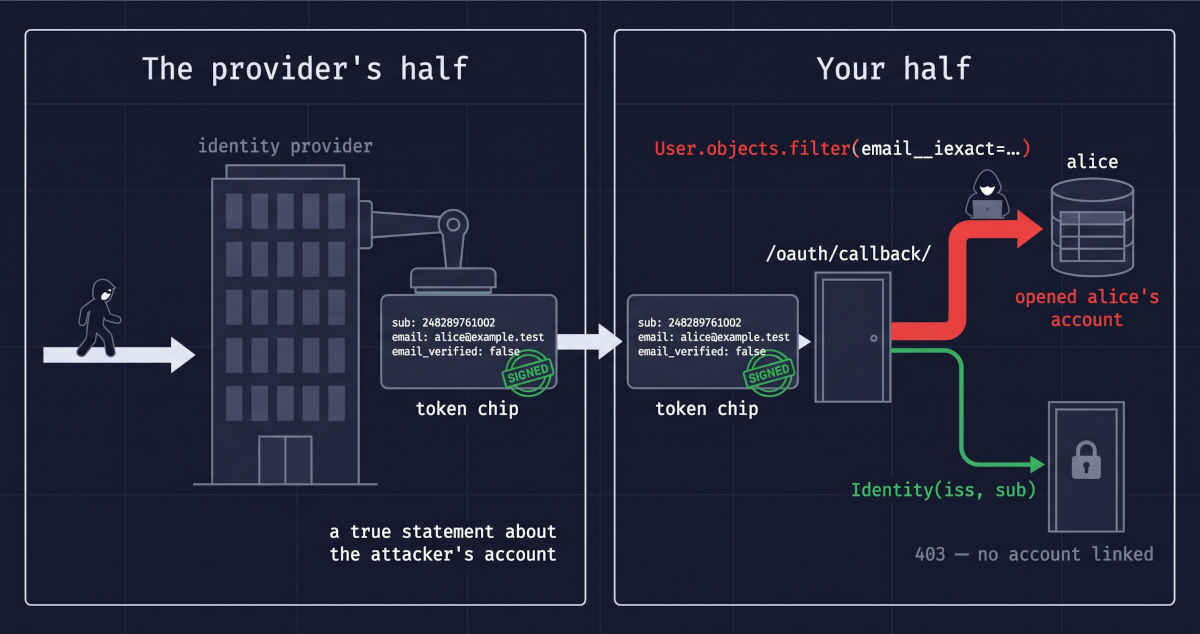
OAuth2 in Django: why a callback that finds the user by the ID token's email lets an attacker in as the victim, and why iss + sub fixes it. OWASP A07.
October 15, 2026
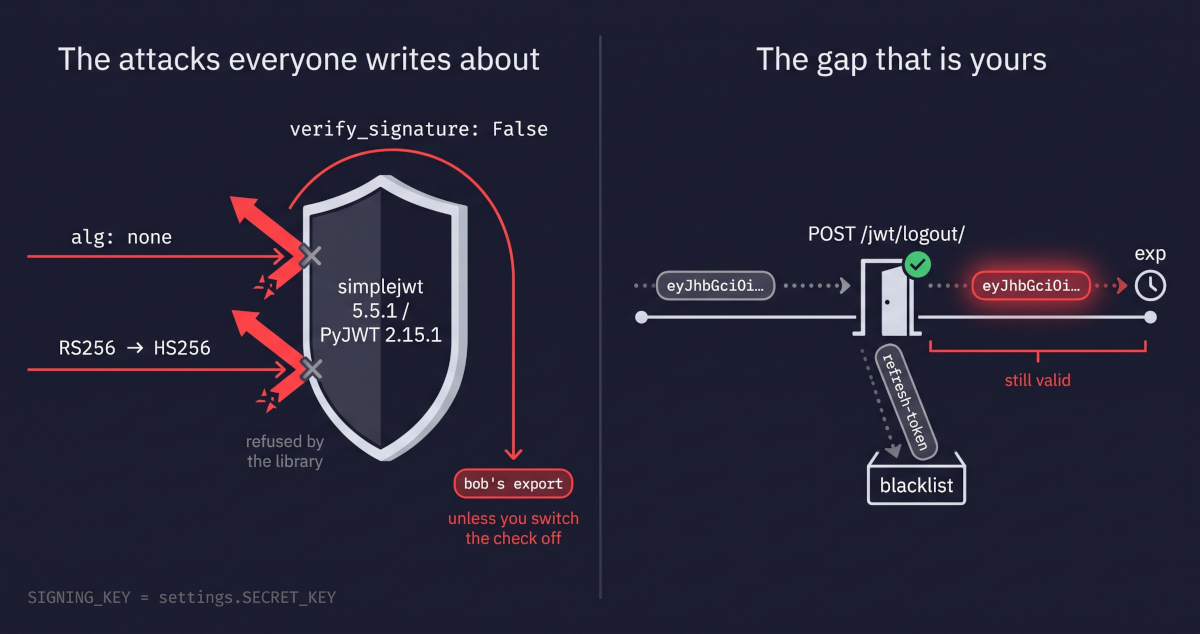
JWT in Django: why alg:none no longer works, why simplejwt signs with your SECRET_KEY, and why logout leaves the access token alive. OWASP A07.
October 8, 2026
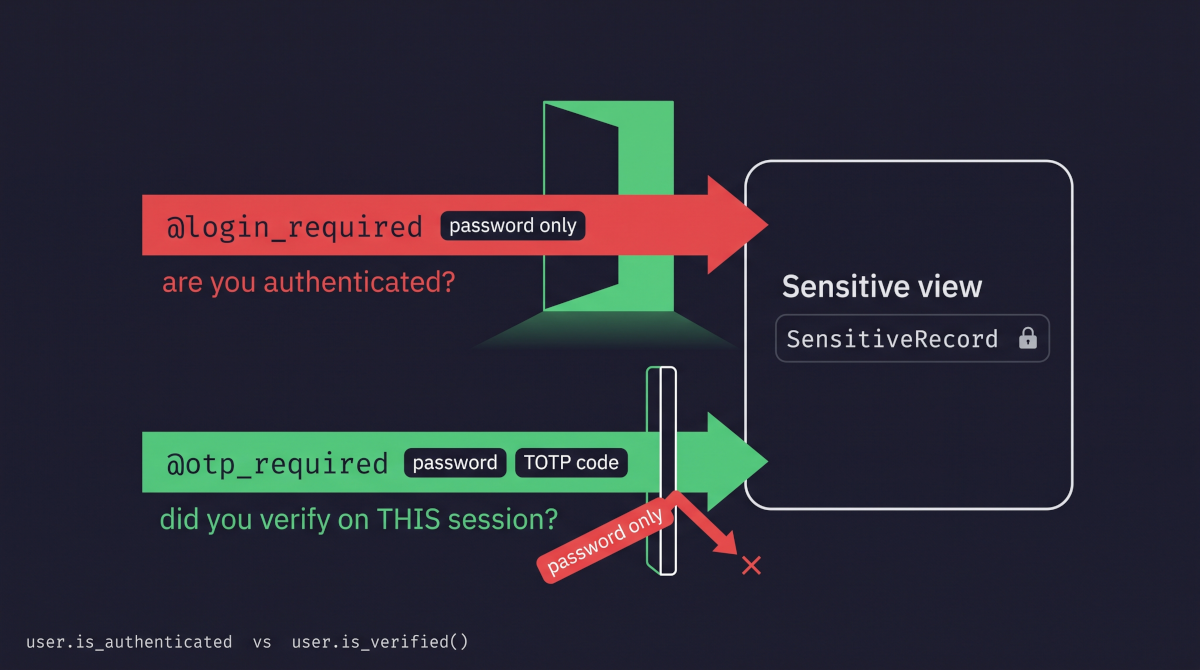
MFA in Django: why @login_required cannot see a second factor, how one path that skips it undoes the whole rollout, and what otp_required fixes. OWASP A07.
Open to Security Engineer co-op, internship and part-time roles — on-site in Victoria, BC, hybrid or remote.
Get in Touch